

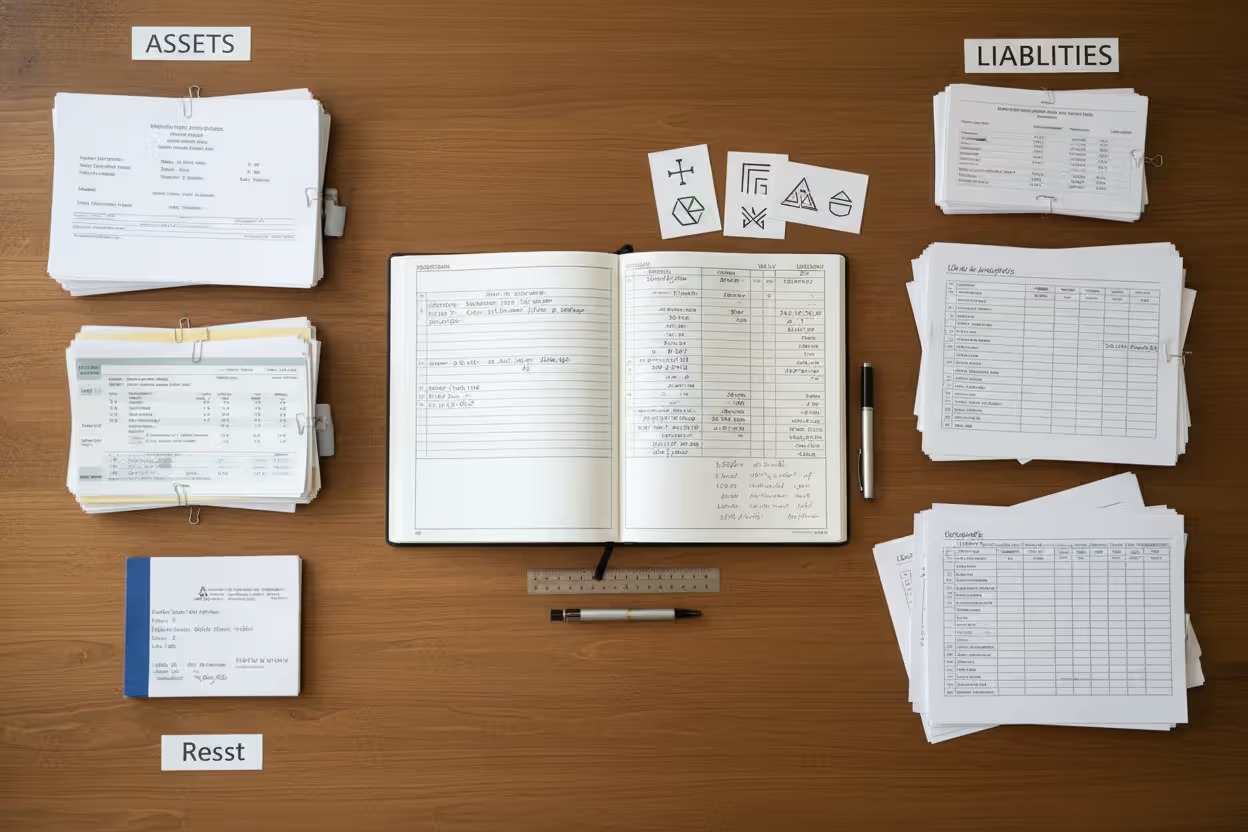
Estate planning questionnaire with financial documents on a desk
Estate Planning Questionnaire Guide

Walking into an estate planning attorney's office unprepared is expensive. You'll sit there at $300-500 per hour trying to remember account numbers, guessing at property values, and promising to "get back to them" on basic questions. An estate planning questionnaire eliminates this waste by organizing everything your attorney needs before you ever shake hands.
Here's what you need to know about these forms, which sections demand the most attention, and how to fill them out without missing critical details that could derail your entire plan.
What Is an Estate Planning Questionnaire?
Think of this document as a detailed snapshot of your financial life, family tree, and final wishes all rolled into one form. Estate planning questionnaires collect specific data points—account numbers, property addresses, beneficiary names, healthcare preferences—that attorneys need to draft your will, trust, power of attorney, and advance directives.

Author: Michael Stratford;
Source: harbormall.net
Most law firms send this paperwork home with you after scheduling your first appointment. You'll complete it on your kitchen table with bank statements spread around you, then bring it to your initial meeting. Some attorneys review it with you in person during that first consultation, asking follow-up questions as you go.
Why bother with all this paperwork? Your attorney can't recommend whether you need a revocable living trust versus a simple will without knowing your asset total. They can't draft guardianship provisions without understanding your family structure. And they definitely can't create healthcare directives without knowing your treatment preferences.
Clients benefit by having a clear roadmap of what information matters. Instead of wondering "what should I tell my attorney," the form spells it out question by question. Attorneys benefit by avoiding the worst-case scenario: drafting documents based on incomplete information, only to discover later that you forgot to mention your rental property in another state or your estranged daughter from a first marriage.
The questionnaire becomes your permanent file foundation. When you update your plan five years later after a grandchild is born, your attorney pulls that original form to see what's changed. It's a legal record of what you owned and wanted at that specific moment in time.
Completing it early matters more than people realize. Your attorney might spot complications—like a special needs child who requires a supplemental needs trust, or retirement accounts with outdated beneficiaries—that need addressing before your first draft gets written. Discovering these issues during the document review phase means starting over, not making minor tweaks.
Key Sections in Every Estate Planning Intake Form
While every law firm designs their own version, most estate planning questionnaire and worksheets hit the same major topics in roughly the same order.
Personal and Family Information
You'll write down the basics: complete legal names (not nicknames), birth dates, Social Security numbers, current home addresses, and phone numbers. Your marital status gets documented with precision—currently married since what date, divorced from whom and when, widowed since when. Premarital agreements get flagged here because they limit what you can leave to your current spouse.
The family section goes deeper than you might expect. List every child, including those from previous relationships, with their full legal names, birth dates, and current addresses. If your daughter goes by "Lizzie" but her birth certificate says "Elizabeth Marie," use Elizabeth Marie. If your son has special needs, substance abuse issues, or you haven't spoken in ten years, note it.
Grandchildren appear on most forms, especially if you're considering leaving them direct inheritances rather than routing everything through their parents. Some attorneys ask about your parents and siblings too—they might serve as backup beneficiaries if your children predecease you.
One common headache: parents listing "Junior" or "III" incorrectly. I've seen "Robert Johnson Jr." throughout a form when the son's legal name is "Robert Allen Johnson II." That discrepancy requires correction before signing anything, which means delays and extra meetings.
Asset and Liability Documentation
Block out serious time for this section. Real estate comes first—write down the street address, approximate current value, and exactly how you hold title. "Joint tenancy with right of survivorship" means something completely different from "tenants in common" in estate planning. The first passes automatically to your co-owner outside your will. The second goes through probate as part of your estate.
Financial accounts need account numbers, institution names, account types (checking, savings, brokerage), rough balances, and current beneficiary designations. Here's where people discover problems. You might find that your checking account still lists your mother—who died in 2018—as payable-on-death beneficiary. Or your IRA names your ex-husband from a marriage that ended in 2003.
Retirement accounts get their own subsection: 401(k)s, 403(b)s, traditional IRAs, Roth IRAs, pension plans, annuities. These assets pass via beneficiary designation, not your will, so who you've named matters tremendously. A recent statement showing current beneficiaries saves guesswork.
Life insurance policies need the insurance company name, policy number, death benefit amount, and beneficiary designation. Term life, whole life, variable universal life—bring the declarations page from each policy.
Business ownership creates complexity. Sole proprietorships, LLCs, S-corps, C-corps, partnerships—your attorney needs to know your ownership percentage, current valuation, and whether buy-sell agreements exist with co-owners. A $3 million business interest might be your largest asset and require succession planning beyond basic estate documents.
Personal property gets summarized rather than itemized. You'll estimate values for vehicles, jewelry, artwork, collections (coins, stamps, wine, baseball cards), antiques, and household furnishings. Nobody appraises their living room couch, but that diamond bracelet from your grandmother probably deserves a number.
Digital assets represent the newest category on most forms. Cryptocurrency holdings, online bank accounts, digital photo libraries, social media profiles, websites you own, domain names, cloud storage—list them all. Include where you store passwords (LastPass, 1Password, Excel spreadsheet, notebook in desk drawer).
Liabilities matter too. List mortgages, home equity lines of credit, car loans, student loans, credit card balances, personal loans from family, and business debts. Your net estate is assets minus liabilities, which affects estate tax calculations and distribution planning.
Author: Michael Stratford;
Source: harbormall.net
Beneficiary and Distribution Preferences
This section forces you to make concrete decisions about who gets what. First-tier beneficiaries receive your assets initially. Backup beneficiaries inherit if your first choices die before you. You might choose "per stirpes" distribution, meaning if your daughter dies before you, her share goes to her children. Or "per capita," where surviving children split everything equally regardless of whether their siblings are alive.
Specific gifts appear here: "My Rolex watch to my son David," "My dining room set to my daughter Jennifer," "My 1967 Mustang to my nephew Tim." These items get distributed before the residuary estate (everything else) gets divided up by percentages.
Conditions show up in this section. Maybe your grandchildren don't receive their inheritance until they turn 25. Maybe distributions can only be used for education, healthcare, and housing until beneficiaries reach 35. Maybe a beneficiary with addiction issues receives money through a trustee who controls distributions, not directly.
Charitable intentions belong here too. Whether you're leaving $10,000 to your church or 25% of your estate to an animal rescue, document it now.
Healthcare and End-of-Life Decisions
These questions feel uncomfortable but matter immensely. If you're unconscious with no reasonable chance of recovery, do you want doctors to keep trying aggressive treatments? What about feeding tubes and hydration when you can't swallow? Do you want to donate organs and tissue?
You'll name a healthcare agent—someone who makes medical decisions when you can't communicate. Choose someone who knows your values and has the backbone to enforce your wishes even if other family members disagree. Name a backup agent in case your first choice is unavailable during an emergency.
HIPAA authorization typically appears here, giving your healthcare agent and other designated people access to your medical records. Without this language, privacy laws prevent your agent from getting critical information from doctors.
Some forms ask about mental health treatment preferences, long-term care preferences, and funeral arrangements. Your preference for burial versus cremation, religious service versus celebration of life, organ donation—writing it down removes guesswork for grieving family members.
How to Complete Estate Planning Prep Questions
Set aside a Saturday morning with coffee, not 20 minutes Tuesday evening between dinner and Netflix. Estate planning prep questions demand focused attention and usually trigger important conversations you've been avoiding.

Author: Michael Stratford;
Source: harbormall.net
Start by gathering paperwork. Grab statements from the last month or two for every financial account you own. Pull out real estate deeds from your file cabinet. Find vehicle titles, life insurance policy declarations, and business partnership agreements. Having actual documents in front of you beats guessing from memory by a mile.
Create a simple spreadsheet before touching the official form. List every asset down the left column, current values in the middle column, and beneficiary designations in the right column. Total it up. Many people are genuinely surprised—their net worth hits $1.2 million when they thought it was maybe $600,000. Real estate equity, retirement accounts, and life insurance death benefits add up faster than expected.
Talk to your spouse first if you're married. You need agreement on the big questions: Who should serve as executor? Who gets guardianship of minor children? Should your brother who's terrible with money receive his inheritance all at once or through a trust? Discovering fundamental disagreements during the attorney meeting wastes billable hours and delays everything.
Call your financial institutions to verify current beneficiaries. Don't assume—confirm. Log into your 401(k) portal and screenshot the beneficiary page. Call your life insurance company and ask them to mail or email current designations. I've seen too many people absolutely certain their beneficiaries were updated in 2020, only to discover their ex-spouse from 2010 is still listed.
Common mistakes kill the efficiency of this entire process. Leaving blanks with a mental note to "figure it out later" guarantees follow-up meetings at $400/hour. Writing vague answers like "my kids split everything equally" without addressing what happens if a child dies before you creates ambiguity your attorney must resolve through additional questions.
Underestimating personal property value ranks high on the mistake list. Your furniture might be garage sale quality, but your jewelry collection, that signed baseball collection, or your vintage motorcycle could be worth serious money. Low estimates can create estate tax surprises.
Hiding family drama backfires spectacularly. If you haven't spoken to your son in eight years, if your daughter has a gambling problem, if you expect your brother to contest your will—tell your attorney upfront. These situations require specific protective language in your documents, not generic boilerplate.
Estate Planning Discovery Questionnaire vs. Attorney Intake Form
Some law firms use these terms interchangeably. Others draw clear distinctions based on when you complete the form and how much detail it demands.
Intake forms usually mean the initial paperwork you fill out when first contacting a law office. Expect basic information: name, contact details, general family structure (married with two kids), rough asset range ($500K-$1M), and what prompted you to call (just had a baby, friend died without a will, turning 65). These forms run two to five pages and take maybe 20 minutes. They help attorneys decide if your case fits their practice and prepare talking points for the first consultation.
Discovery questionnaires go substantially deeper. After you've hired the attorney and committed to the process, they send you home with this comprehensive document. It demands specifics: exact account numbers, precise property addresses, detailed family histories, specific distribution preferences. Discovery forms might run 15 pages and require three hours of focused work. You'll complete this between your first consultation and your second meeting where you'll review the attorney's recommendations.
The discovery phase sometimes involves multiple rounds. Your attorney reviews your initial responses, then emails follow-up questions. "You mentioned a rental property—is it titled in your name alone or jointly with your brother?" "Your daughter has special needs—does she receive SSI or Medicaid benefits?" "You listed a business interest—do you have a buy-sell agreement with your partners?"
Neither approach beats the other objectively. Single comprehensive forms get all paperwork done at once but feel overwhelming initially. Two-stage processes spread the work out but create more back-and-forth.
Free Estate Planning Questionnaire PDF Templates
Google "estate planning questionnaire pdf" and you'll find dozens of downloadable templates. Quality ranges from excellent to dangerously inadequate.
Strong templates cover all major categories: personal details, complete family information, thorough asset documentation, beneficiary preferences, healthcare directive questions, and executor selection. They provide enough space for detailed answers, not just checkboxes. Look for forms that ask about contingent beneficiaries, not just primary ones, and that include sections on digital assets and business interests.
State-specific issues matter more than most people realize. Nine states (Arizona, California, Idaho, Louisiana, Nevada, New Mexico, Texas, Washington, and Wisconsin) treat marital property fundamentally differently than the other 41 states. Transfer-on-death deeds work in some states but not others. Homestead exemptions vary wildly. A template designed for New York might miss critical issues for Texas residents.
Generic national templates can work for initial organization, but verify they address your state's quirks. Better option: download forms from attorneys licensed in your state. Many estate planning practices offer questionnaires on their websites as both client service and marketing.
DIY worksheets offer obvious advantages. Work at your own pace, no appointment scheduling, zero cost. Completing a template educates you about estate planning concepts and organizes information you'll eventually need anyway, even if you hire an attorney later.
The downsides are substantial. Templates don't provide legal advice or flag issues unique to your situation. A generic form won't tell you that your blended family needs a QTIP trust, or that your special needs child requires a first-party versus third-party special needs trust to protect government benefits. Using templates to prepare for attorney meetings makes sense. Using them to replace professional guidance creates dangerous gaps in your plan.
Some people use free templates for comparison shopping. They complete a thorough questionnaire, then schedule consultations with three different attorneys to evaluate their recommendations. This works if you're organized and want to compare approaches, but remember most attorneys charge $200-400 for initial consultations.

Author: Michael Stratford;
Source: harbormall.net
Common Mistakes When Filling Out Estate Planning Worksheets
Even detail-oriented people make predictable errors on these forms. Knowing the common traps helps you sidestep them.
Incomplete asset lists cause the most problems. People forget about that old savings account from their first job. They omit the stock certificates in their safe deposit box. They don't mention the timeshare in Florida or the inherited mineral rights in Oklahoma. Every missing asset potentially creates a mess for your executor. Strategy: review last year's tax return (Schedule B shows interest and dividends, suggesting accounts you might forget), check statements from every financial institution, and physically walk through your house noting valuables.
The connection between questionnaire thoroughness and plan quality is absolute."I can draft legally perfect documents all day long, but if my client forgot to mention their vacation condo in Colorado, their estranged son from a first marriage, or their $200,000 in credit card debt, the plan won't achieve their goals. The questionnaire isn't paperwork for paperwork's sake—it's the foundation supporting everything else. Clients who invest real time completing it thoroughly always end up with stronger plans and far fewer expensive revisions later
— Jennifer Martinez
Outdated beneficiary information creates nightmare scenarios. Your IRA from 1995 still lists your college girlfriend. Your life insurance names your mother who died in 2016. Your 401(k) designates your ex-spouse from a 2008 divorce. Beneficiary designations override your will completely, so these accounts will pass to the named person no matter what your will says. Update every single beneficiary designation before filling out your questionnaire, then document the corrected information.
Vague distribution instructions guarantee family conflict. "Split my jewelry among my three daughters" sounds reasonable until your executor must decide who gets your grandmother's engagement ring that everyone wants. Prevent this: "My grandmother's 2-carat diamond engagement ring to my daughter Jennifer; my pearl necklace to my daughter Sarah; my emerald bracelet to my daughter Michelle; remaining jewelry divided equally by agreement or sold and proceeds split three ways."
Missing digital asset information creates modern headaches. Your executor needs access to online banking, email accounts, cryptocurrency wallets, social media profiles, and cloud storage. Without passwords or recovery information, these assets might vanish permanently. Bitcoin worth $80,000 but no password? It's gone forever. Document what digital assets exist and where you've stored access credentials.
Ignoring special circumstances undermines your entire plan. If a beneficiary receives disability benefits, has creditor problems, struggles with addiction, or is married to someone you don't trust, standard distribution language might destroy rather than help them. A direct inheritance could disqualify someone from Medicaid. A lump sum to someone with gambling issues could disappear in six months. Flag these situations clearly so your attorney can design protective structures.
Treating the questionnaire as a one-time exercise means your plan grows stale. Marriages, divorces, births, deaths, major purchases, interstate moves—these changes often require plan updates. Review your questionnaire every three to five years minimum, or immediately after any major life event. Some attorneys send update forms periodically as gentle reminders to review your plan.
Assuming joint ownership solves everything represents a dangerous misconception. Joint property with rights of survivorship does pass automatically to the surviving owner, but what if both owners die simultaneously in a car accident? What if the survivor becomes incapacitated? Joint ownership also exposes your assets to the co-owner's creditors and can trigger unintended gift tax consequences if the co-owner isn't your spouse.
Estate Planning Questionnaire Sections: What to Include
| Section Name | Information Required | Documents Needed | Why It Matters |
| Personal Details | Complete legal names, birth dates, Social Security numbers, home addresses, marital timeline, citizenship | Birth certificates, marriage certificates, divorce decrees, prenuptial agreements | Guarantees documents use legally correct names; identifies choice-of-law issues; prenups limit available distribution options |
| Assets | Property addresses and estimated values, account details for all financial holdings, business ownership stakes, valuable personal items, digital property | Deeds, recent account statements, business operating agreements, vehicle titles, insurance policy declarations | Establishes total estate value, separates probate from non-probate assets, identifies tax planning opportunities |
| Beneficiaries | Primary and backup recipients for each asset, distribution percentages or amounts, any conditions on inheritance | Current beneficiary forms from every financial institution and insurance company | Confirms assets transfer to intended recipients; aligns will provisions with beneficiary designations |
| Healthcare Directives | Treatment preferences for terminal conditions, organ donation decisions, healthcare agent appointment, HIPAA permissions | Existing healthcare documents if previously created | Preserves your medical decision-making authority and prevents family members from making agonizing choices during crises |
| Executor/Trustee Selection | Full names and contact information for estate representative, successor trustees, backup options | None typically needed | Designates who will handle estate administration and trust management; lets attorney evaluate whether your choices are practical |
| Digital Assets | Comprehensive list of online accounts, cryptocurrency holdings, digital files and photos, location of password storage | Cryptocurrency account statements; documentation of where login credentials are kept | Guarantees executor can locate and manage digital property; prevents permanent loss of valuable online assets |
This attorney perspective reinforces why rushing through forms or skipping questions creates expensive problems. Your lawyer can only address situations they know about. A thorough questionnaire reveals your complete picture, allowing your attorney to identify potential complications and recommend solutions before documents get drafted.
Frequently Asked Questions About Estate Planning Questionnaires
An estate planning questionnaire converts the vague goal of "getting my affairs organized" into specific, actionable tasks. By methodically documenting your personal details, assets, family relationships, and preferences, you give your attorney the raw materials required to build a plan that protects the people and causes you care about.
The hours you spend completing these forms carefully yield benefits throughout the planning process and afterward. Accurate, comprehensive information produces better legal advice, reduces revision cycles, and ultimately results in a more effective estate plan. It also creates a valuable reference for your family, documenting where assets are held and important details they'll need after you're gone.
View your questionnaire as an opportunity rather than an obligation. The process frequently uncovers planning needs you hadn't considered, prompts overdue family conversations, and provides clarity about your financial situation. Whether you're working with an attorney or organizing independently, treat this document as your estate plan's foundation—because that's precisely what it is.
Start gathering your information this week. The peace of mind that comes from having a comprehensive, well-documented estate plan justifies every minute you invest in the questionnaire that makes it possible.
Related Stories

Read more

Read more




The content on this website is provided for general informational and educational purposes only. It is intended to explain concepts related to estate planning, wills, trusts, tax strategies, and financial legacy planning.
All information on this website, including articles, guides, worksheets, and planning examples, is presented for general educational purposes. Estate planning situations may vary depending on personal circumstances, financial structures, legal regulations, and jurisdiction.
This website does not provide legal, financial, or tax advice, and the information presented should not be used as a substitute for consultation with qualified legal, tax, or financial professionals.
The website and its authors are not responsible for any errors or omissions, or for any outcomes resulting from decisions made based on the information provided on this website.