

Dark wooden desk with legal documents in blue covers, fountain pen, glasses, and a small decorative wooden house model representing estate planning and living trust concept
Living Trust and Estate Planning Guide

Most people get this backwards. They either think setting up a living trust checks every estate planning box, or they figure trusts are something only wealthy people need. Neither assumption holds up when you actually look at how these tools work—and what happens when pieces go missing.
Here's what actually matters: A living trust handles certain jobs exceptionally well, but it can't do everything. Your family's situation, where you live, what you own, and who depends on you all determine whether including a trust makes sense and how it should fit with your other documents.
What Is a Living Trust in Estate Planning
Think of a living trust as a container you create now, while you're alive and capable. You transfer ownership of your assets into this container, but here's the key part—you still control everything inside it. You're typically named as the trustee, meaning you manage these assets exactly as you did before, with zero restrictions on buying, selling, or changing anything.
When you die or become unable to manage your affairs, the person you've named as successor trustee takes over. They step in without needing court permission, without waiting for probate proceedings, and without making your financial details part of the public record.
Estate planning living trust options break down into two categories, and the difference matters. A revocable trust stays under your control. Don't like how you set up distributions? Change it. Want to remove certain assets? Go ahead. Decide your designated trustee isn't the right choice anymore? Pick someone else. You maintain total flexibility until you die or lose mental capacity.
An irrevocable trust works differently—once you sign it and transfer assets in, you generally can't undo those decisions. Why would anyone choose this? Because giving up control provides benefits revocable trusts can't offer. Assets in properly structured irrevocable trusts may be shielded from creditors, excluded from your taxable estate, or protected from being counted when determining Medicaid eligibility. The asset legally belongs to the trust now, not to you.
Living trust estate planning solves specific problems. It keeps your estate out of probate court for assets the trust owns. It maintains privacy, since unlike wills, trust documents don't become public when you die. It allows immediate access during incapacity—your successor trustee can pay your mortgage, manage investments, and handle financial obligations the moment you can't, without filing court paperwork or waiting for a judge's approval.
But notice that phrase "for assets the trust owns." Property still titled in just your name? The trust provides zero protection for those assets. This gap causes more problems than almost any other estate planning mistake.

Author: Rebecca Langford;
Source: harbormall.net
How Living Trusts Work with Other Estate Planning Documents
You can't replace a complete estate plan with just a trust. The documents serve different purposes, and you need multiple pieces working together.
Start with wills. Even people with fully-funded trusts need them. If you have kids under 18, only a will can nominate who should raise them if you die. Courts won't look at trust documents when deciding guardianship—they need a will. You'll also acquire assets right before you die that never make it into the trust. A bank account opened two weeks before a fatal accident, an inheritance you received but hadn't retitled yet, even a tax refund that arrives after your death. A "pour-over will" catches these stragglers and directs them into your trust, where they'll be distributed according to the plan you laid out. Yes, those specific assets go through probate first, defeating one purpose of the trust, but at least they end up with the right people.
Powers of attorney cover territory trusts can't touch. Your successor trustee manages assets inside the trust during your incapacity, but they have no authority over your Social Security decisions, filing tax returns, dealing with the IRS, or handling assets that never made it into the trust. A durable financial power of attorney designates someone to manage these non-trust matters when you can't. Without it, your family may need a conservatorship—a court process that's expensive, time-consuming, and exactly what you're trying to avoid.
Healthcare documents operate in a completely separate sphere. Living wills, healthcare powers of attorney, and advance directives specify your medical treatment preferences and designate someone to make healthcare decisions when you're incapacitated. Trusts deal with property and money, period. They provide no framework for medical choices.
Beneficiary designations trump everything. The beneficiary you name on your IRA, 401(k), life insurance policy, or payable-on-death bank account receives those assets directly when you die, regardless of what your trust or will says. You could specify in your trust that all assets should be divided equally among your three children, but if your life insurance policy names only your oldest child, that's where the death benefit goes. Estate planning with trusts requires aligning all these designations so they work together instead of contradicting each other.
When You Need Both a Will and a Living Trust
Every single person with a trust needs a will too. No exceptions, despite what you might have heard.
Parents absolutely need wills to name guardians. Courts deciding who raises your children won't consider trust documents, won't care about distribution provisions, and won't accept trustee nominations as guardian preferences. Without a will specifying your choice, interested parties petition the court, a judge reviews the options, and your kids go to whoever the judge thinks is best. That might align with your wishes. It might not.
Pour-over wills function as a safety net for funding mistakes. Forget to retitle an account? Inherit property shortly before you die? Buy a new car but don't get around to transferring the title before a fatal accident? The pour-over will directs all individually-owned assets into your trust after probate. You lose the probate-avoidance benefit for those items, but they still flow through your trust's distribution plan rather than following intestate succession laws.
Living Trust vs Full Estate Plan

Author: Rebecca Langford;
Source: harbormall.net
The question "living trust vs estate planning" reflects a fundamental misunderstanding. A trust is one tool within estate planning, not an alternative to it.
Marketing from online document services has convinced many people that purchasing a trust package completes their planning. It doesn't. A complete estate plan includes your trust plus a pour-over will, durable financial power of attorney, healthcare power of attorney, HIPAA authorization allowing medical providers to discuss your condition with designated people, and typically a living will or advance directive. Depending on your situation, you might also need a special needs trust for a disabled beneficiary, an irrevocable life insurance trust to reduce estate taxes, testamentary trusts created in your will for minor beneficiaries, or asset protection structures for liability concerns.
Just having a trust leaves dangerous gaps. You get no incapacity planning for assets outside the trust. No healthcare decision framework. No guardian nominations. No authority for your family to resolve tax disputes, pursue insurance claims, or manage digital assets.
Tax planning illustrates another limitation. A revocable living trust changes nothing about your income taxes while you're alive—you still report all trust income on your personal return. It provides minimal estate tax benefits, mainly helping couples maximize their combined estate tax exemption. Sophisticated tax reduction requires additional strategies: charitable remainder trusts, grantor retained annuity trusts, family limited partnerships, or intentionally defective grantor trusts. These specialized tools work alongside a living trust, not instead of one.
| What You Get | Trust Documents Only | Complete Estate Plan |
| Included Documents | Trust agreement, maybe a basic pour-over will | Trust agreement, comprehensive will, financial power of attorney, healthcare power of attorney, HIPAA release, living will or advance directive |
| Probate Protection | Only for assets actually transferred into the trust | Trust handles major assets; will provides backup for everything else |
| Medical Decision Authority | Nothing—trusts don't address healthcare | Healthcare power of attorney and living will specify preferences and decision-maker |
| Naming Guardians for Minor Kids | Trusts can't nominate guardians | Will includes guardian nominations that courts will consider |
| Tax Reduction Strategies | Limited to basic estate tax threshold planning | Multiple strategies across income, gift, estate, and generation-skipping transfer taxes |
| Creditor Protection | Minimal with revocable trust; stronger with irrevocable | Multiple layers through trust structures, LLC formations, and strategic titling |
| Incapacity Coverage | Only trust-owned assets | Complete financial and medical authority through coordinated documents |
| Typical Investment | $1,500–$3,500 | $2,500–$6,000+ based on complexity |
Who Should Include a Living Trust in Their Estate Plan
Asset value offers a starting point, though the right threshold varies dramatically. Estates holding $200,000+ in non-retirement assets often justify a trust's cost and complexity, but state law matters more than any national rule of thumb.
Where you live determines whether probate is expensive and slow or relatively painless. California charges statutory fees calculated on gross estate value—about 4-5% before you even account for extraordinary fees. An $800,000 estate pays roughly $36,000 in probate fees even if administration is straightforward. Florida offers simplified processes for estates under $75,000 and streamlined summary administration for estates under $75,000 with no creditor issues. Texas provides independent administration that requires minimal court supervision for most estates. Before deciding whether trust benefits outweigh setup costs, research your specific state's probate fees, typical timeline, and complexity.
Family dynamics often drive the decision more than asset values. Second marriages where you want to provide for your current spouse but ensure children from your first marriage ultimately inherit the assets? A trust can specify exactly these terms and prevent your spouse from changing beneficiaries after you die. A simple will might leave everything to your spouse, trusting they'll eventually distribute to your kids, but they could remarry, write a new will, and cut your children out entirely.
Parents of special needs children need supplemental needs trusts that provide support without disqualifying their child from SSI or Medicaid benefits. Direct inheritances—even small ones—can eliminate eligibility for government assistance that provides crucial healthcare and services.
Concerned about a beneficiary's judgment? Trusts can restrict distributions, require trustee approval for large expenditures, or delay inheritance until the beneficiary reaches a certain age. Worried about a beneficiary's creditors, potential divorce, or substance abuse issues? Properly structured trusts can protect inherited assets from these threats.
Own real estate in multiple states? You'll face probate proceedings in every state where you own property unless that property is held in a trust. Ancillary probate means hiring attorneys in each state, paying multiple sets of court fees, and dealing with different procedural requirements. A vacation home in Florida, rental property in Arizona, and primary residence in New York means three separate probate proceedings. A trust holding all three properties means one trust administration, no matter how many states are involved.
Privacy motivates many people. Probate files become public record. Anyone can request copies of your will, inventory of assets, creditor claims, and beneficiary information. They can see what you owned, what you owed, and who received what. Celebrities, business owners, and people who simply value financial privacy often choose trusts because trust documents remain private, shared only with trustees and beneficiaries.
Business ownership creates unique concerns. If you own a business and become incapacitated, who has authority to sign contracts, hire and fire employees, manage cash flow, or make strategic decisions? Without a funded trust, your family may need court proceedings before anyone can act. Your successor trustee can step in immediately, maintaining business operations without interruption that could destroy value you spent years building.
Setting Up Estate Planning with Trusts
Creating a trust that actually works requires multiple decisions and implementation steps. Skip parts of this process and you've likely wasted your money.
Choosing the Right Trust Type
Most people benefit from revocable living trusts. You want probate avoidance, privacy, and incapacity planning without giving up control or locking in permanent decisions. Life changes—kids are born, marriages end, relationships evolve, assets accumulate or disappear. Revocable trusts adapt to these changes because you can modify or revoke them anytime before you die or lose capacity.
The tradeoff? Revocable trusts provide no asset protection from your creditors (since you still control the assets) and create no income tax benefits (you still pay tax on all trust income). If someone sues you and wins a judgment, they can reach assets in your revocable trust just as easily as assets in your individual name.
Irrevocable trusts serve specialized purposes and require careful analysis before implementation. An irrevocable life insurance trust (ILIT) owns your life insurance policy, removing the death benefit from your taxable estate. For someone with a $10 million estate and a $2 million policy, this move could save $800,000 in federal estate taxes. But once the trust owns the policy, you can't change your mind, you can't borrow against the policy, and you typically need to make annual gifts to the trust to pay premiums.
Qualified personal residence trusts (QPRTs) let you transfer your home to beneficiaries now at a reduced gift tax value, but you can only live there for a predetermined term. If you die before the term ends, the entire plan fails and the house ends up in your taxable estate anyway.
Medicaid planning trusts shield assets from long-term care costs, but you must establish them at least five years before applying for Medicaid. Transfer assets too late and you face penalty periods when Medicaid won't pay for your care.
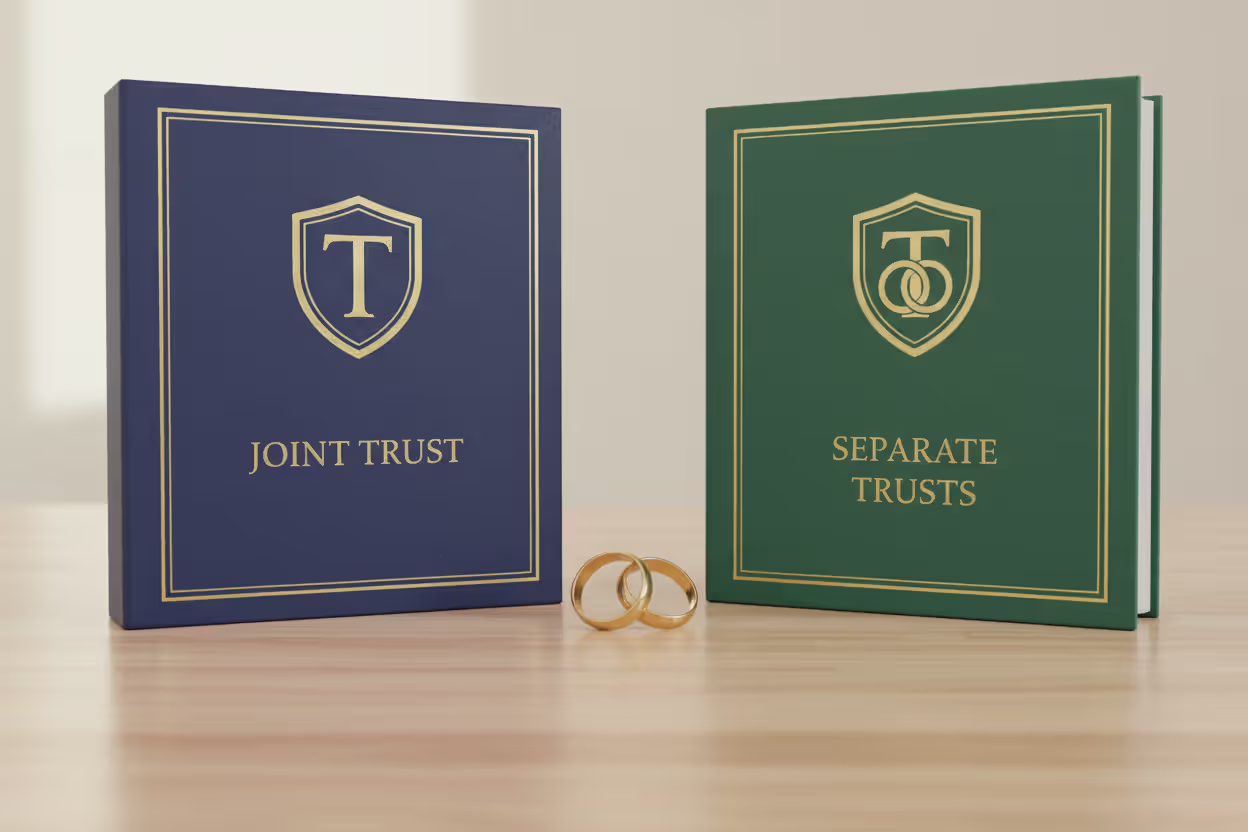
Married couples decide between individual trusts or a joint revocable trust. Joint trusts simplify administration—one document, one set of assets, one process. They work well when spouses share planning goals, have similar beneficiaries, and completely trust each other. First marriages where you're leaving everything to each other and then your shared children? A joint trust usually makes sense.
Author: Rebecca Langford;
Source: harbormall.net
Separate trusts provide independence. You each control your own assets, maintain separate property rights, and can name different beneficiaries. Second marriages often call for separate trusts when you want to provide for your spouse during their lifetime but ensure your children from a previous marriage ultimately inherit your assets. Separate trusts also protect premarital assets and inheritances you want to keep separate.
Funding Your Living Trust
Trust funding determines whether your trust works or becomes expensive decoration. An unfunded trust accomplishes nothing—your assets still go through probate as if the trust never existed.
Real estate transfers require new deeds. For each property, you'll record a deed changing ownership from your individual name (or joint names) to your trust. "John Smith" becomes "John Smith, Trustee of the Smith Family Trust dated January 15, 2024." Each property needs its own deed, properly executed according to your state's requirements, and recorded with the county where the property is located.
Most mortgage lenders won't require refinancing when you transfer property into your revocable trust, since you still control the trust. But check your loan documents and confirm with your lender first. Some mortgages include due-on-transfer clauses that could theoretically allow the lender to demand full payment when ownership changes.
Financial accounts need retitling. Banks, brokerages, and investment firms all have specific forms for changing account ownership to your trust's name. Some institutions resist trust ownership of certain account types, particularly checking accounts. Be persistent. You may need to speak with a supervisor or move your accounts to a more trust-friendly institution.
Retirement accounts create a special situation—generally, don't retitle IRAs or 401(k)s into your trust during your lifetime. Changing ownership from you personally to a trust triggers immediate taxation of the entire account balance. Instead, name the trust as beneficiary if you want trust control over how distributions are made after your death. This preserves tax deferral during your life while still allowing trust provisions to govern post-death distributions.
Business interests require careful review. Check partnership agreements, LLC operating agreements, and corporate bylaws before transferring business ownership into a trust. Many agreements restrict transfers or require consent from other owners. Corporations need new stock certificates issued in the trust's name. LLCs require assignment of membership interests, properly documented in company records.
Personal property—furniture, jewelry, artwork, collections—can be transferred through a general assignment rather than individual transfers for each item. However, vehicles, boats, and other titled property need formal title changes through the DMV or equivalent agency.
Coordinating with Existing Estate Documents
Review every beneficiary designation after creating your trust. Retirement accounts, life insurance, annuities, payable-on-death bank accounts, and transfer-on-death investment accounts all pass directly to named beneficiaries, completely bypassing your trust and will. If your trust creates a marital trust to provide for your spouse while preserving assets for your children, but your $750,000 IRA names your children directly, your spouse loses that intended support.
Update your will to create the pour-over provision. This relatively simple addition catches any assets you forgot to transfer, couldn't transfer, or acquired after creating the trust. Without a pour-over will, non-trust assets might distribute under an old will or, if you have no will, under your state's intestacy statute.
Confirm your powers of attorney and healthcare directives are current. Creating a trust provides a natural opportunity to review these documents and verify they still reflect your wishes and designate appropriate people.
Expect the process to take time. Document preparation might take two to four weeks once you've provided information to your attorney. Then funding begins—recording deeds, retitling accounts, transferring business interests, updating beneficiary designations. Complete funding typically requires several months as you work through various institutions and their paperwork requirements. Complex situations involving multiple properties, business interests, or specialized trust types might take six to twelve months for full implementation.
Cost varies significantly by location and complexity. Attorneys in major metropolitan areas generally charge more than those in rural areas. Simple revocable living trusts typically cost $1,500–$3,500 for an individual or $2,000–$4,500 for a married couple. A complete estate planning package including the trust, will, powers of attorney, and healthcare directives usually runs $2,500–$6,000. Complex planning with multiple trust types, business succession planning, or sophisticated tax strategies can easily exceed $10,000.
Online document services charge $300–$1,000 but provide no legal advice, no customization for unusual circumstances, no review of whether a trust actually makes sense for you, and no guidance on funding. The documents might be technically correct but completely wrong for your situation.
Common Mistakes When Combining Trusts and Estate Planning

Author: Rebecca Langford;
Source: harbormall.net
Failing to fund the trust ranks as the most common and costly mistake. Estate planning attorneys report that 60–70% of trusts they encounter during probate are partially or completely unfunded. People pay thousands of dollars for trust documents, sign them, put them in a drawer, and never transfer any assets into the trust. When they die, everything goes through probate exactly as if the trust never existed.
Partial funding creates dual administration headaches. Some assets flow through the trust, others through probate. Your family deals with both processes simultaneously, paying probate fees and attorney costs for non-trust assets while also managing trust administration. They're essentially running two separate estates.
Beneficiary designation conflicts produce unintended outcomes. You specify in your trust that all assets should fund a special needs trust for your disabled son, protecting his government benefits. But your $400,000 life insurance policy names him directly. The insurance pays him directly, immediately disqualifying him from SSI and Medicaid. Your careful planning for all other assets is undermined by one beneficiary designation you forgot to update.
Ignoring trust maintenance means operating under outdated terms. You create a trust in 2010 when your kids are minors, specifying distributions at age 25. By 2025, they're 28 and 30, responsible adults with their own families. But you never updated the trust to remove age restrictions that no longer make sense. Or you move from California to Florida, and your trust contains California-specific provisions that create problems under Florida law.
Skipping the pour-over will leaves unfunded assets without direction. Some people think the trust eliminates any need for a will. Then assets outside the trust—that unexpected inheritance, the bank account they opened but forgot to retitle, the lawsuit settlement that arrived after death—have no designated destination. State intestacy laws take over, sending property to people you never intended to benefit.
Failing to inform key people creates administration chaos. Your successor trustee doesn't know the trust exists. Or they know about it but can't find the document. Or they find it but have no idea what accounts are actually in the trust or where those accounts are held. Keep the original trust in a secure but accessible location—a fireproof safe at home or a safe deposit box—and tell your successor trustee exactly where it is and how to access it. Consider giving them a copy for their records.
Neglecting tax strategy coordination causes expensive mistakes. You name your trust as IRA beneficiary to control distributions, but the trust wasn't drafted with the specific language required to qualify for the stretch distribution rules. Instead of distributions spreading over your beneficiaries' lifetimes, the entire IRA must be distributed within ten years, accelerating taxation. Or you make large gifts to fund an irrevocable trust without considering how this affects your lifetime gift tax exemption, wasting valuable tax benefits.
The biggest misconception I encounter is clients who believe signing a trust document completes their estate planning.A trust is powerful for what it does, but it's one instrument in the orchestra. You need the entire ensemble—will, powers of attorney, healthcare directives—all playing the same piece of music. I can't count how many families have discovered during a crisis that Dad's trust existed on paper but never actually owned any assets, or that Mom never signed her healthcare directive even though it was sitting in the estate planning binder. Real planning means creating multiple coordinated documents and actually implementing them—transferring assets, updating beneficiaries, informing key people—not just producing impressive-looking paperwork that sits in a drawer
— Jennifer Sawday
FAQ: Living Trust and Estate Planning
Living trusts handle specific tasks exceptionally well—probate avoidance, privacy protection, and seamless management during incapacity for assets they actually own. But they can't function as standalone planning solutions. You still need wills for guardian nominations and catching unfunded assets, powers of attorney for non-trust financial matters, and healthcare directives for medical decisions.
Whether to include a living trust in your estate plan depends on asset values, state probate procedures, family complexity, real estate holdings, and privacy preferences. No universal threshold or one-size-fits-all rule applies. Your situation determines whether benefits justify costs.
Proper implementation extends beyond creating the trust document to funding it completely, aligning beneficiary designations, and maintaining the plan as circumstances change. The most common failures—particularly funding mistakes and coordination gaps—determine whether your trust achieves intended goals or creates additional problems for your family.
Professional guidance typically justifies its cost given the complexity of integrating trusts with other planning tools and the serious consequences of errors. Online documents might save money upfront but often create expensive problems later.
Your estate plan should reflect your specific situation, goals, and concerns rather than generic templates or marketing claims. If a living trust makes sense for your circumstances, ensure it's properly integrated within a complete planning framework addressing all aspects of asset transfer, incapacity planning, and end-of-life decision-making. Partial planning often proves worse than no planning because it creates false confidence that you've protected your family when significant gaps remain.
Related Stories

Read more

Read more




The content on this website is provided for general informational and educational purposes only. It is intended to explain concepts related to estate planning, wills, trusts, tax strategies, and financial legacy planning.
All information on this website, including articles, guides, worksheets, and planning examples, is presented for general educational purposes. Estate planning situations may vary depending on personal circumstances, financial structures, legal regulations, and jurisdiction.
This website does not provide legal, financial, or tax advice, and the information presented should not be used as a substitute for consultation with qualified legal, tax, or financial professionals.
The website and its authors are not responsible for any errors or omissions, or for any outcomes resulting from decisions made based on the information provided on this website.