
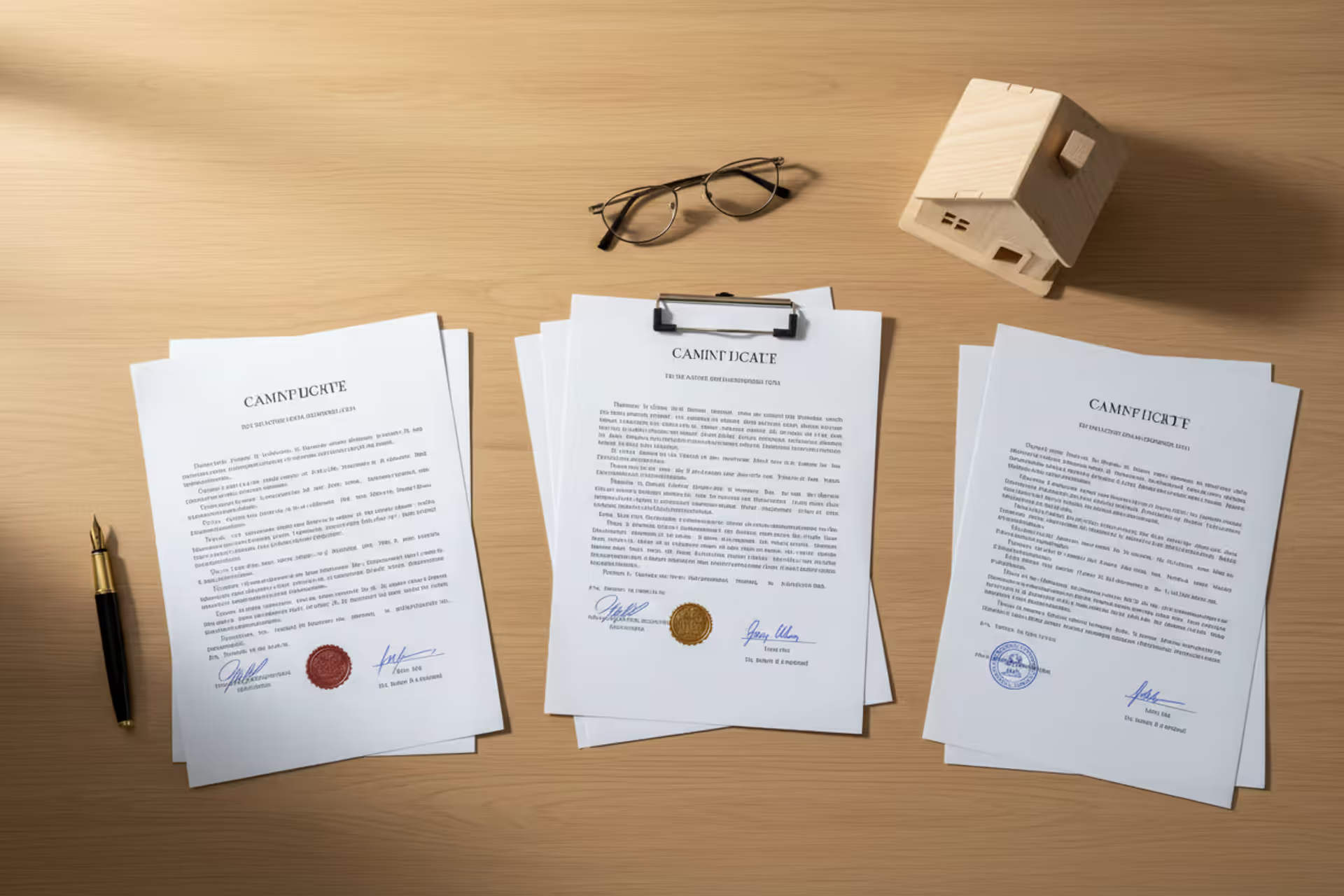
Top view of a wooden desk with three separate stacks of legal documents, a fountain pen, glasses, and a small house model
Estate Planning vs Trust vs Will Explained

Content
Content
If you've ever looked into protecting your assets and planning for your family's future, you've probably encountered these three terms—and wondered why they keep getting mixed up. Here's the truth: they're related, but they're not interchangeable, and confusing them can leave your family facing problems you meant to prevent.
Think of it this way: a will is a single legal paper. A trust is a specific structure you set up to hold property. Estate planning? That's the whole game plan that might use both tools—or neither, depending on what you need.
Getting this right matters. The wrong choice can mean your family spends months in court, thousands on legal fees, or ends up fighting over assets you meant to divide peacefully.
What Is Estate Planning?
Estate planning means taking stock of everything you own and everyone you love, then building a complete system to protect both. It's not about signing one document and calling it done. You're creating a roadmap that covers what happens to your stuff when you die and who steps in to make choices if you're alive but can't speak for yourself.
Most solid estate plans pull together several moving parts:
- A last will and testament
- Possibly one or more trusts, depending on your situation
- Durable financial power of attorney
- Medical power of attorney or proxy
- Advance directive for healthcare
- Updated beneficiary forms for retirement accounts and insurance policies
- Guardian designations if you have kids under 18
- Succession arrangements if you run a business
- Strategies to reduce what you'll owe in taxes
You're solving four big problems: deciding who inherits what, choosing who makes calls if you can't, cutting down on taxes and court costs, and preventing family blowups after you're gone. A will handles exactly one slice of that picture. Estate planning tackles all of it.
Here's what trips people up: they assume this level of planning only matters if you're sitting on millions. Wrong. If you've got kids who depend on you, property with your name on it, or strong feelings about your medical care, you need a plan. Sure, the bigger your assets, the more complex the work gets—but the basic need exists whether you own a mansion or a modest home.

Author: Rebecca Langford;
Source: harbormall.net
What Is a Trust and How Does It Work?
A trust creates a separate legal pocket where you place assets—your house, investment accounts, savings—and name someone (the trustee) to manage them for whoever benefits (the beneficiaries). You write the rules in the trust document: when money gets distributed, under what conditions, and who's in charge of enforcement.
Trusts split into two main types based on whether you can change your mind later.
Revocable living trusts give you maximum flexibility. While you're alive and thinking clearly, you maintain complete authority—you can modify terms, add or remove assets, even dissolve the whole thing. Most people name themselves as the initial trustee and beneficiary, keeping total control. After you die, the successor trustee you picked steps into your shoes and hands out assets based on your written instructions. No probate court required.
Irrevocable trusts lock in once you sign. You're surrendering direct ownership, which sounds scary—but that trade brings powerful advantages. Assets inside become unreachable by your creditors, they drop out of your taxable estate (potentially saving hundreds of thousands in estate taxes), and they won't disqualify someone from needs-based government assistance like Medicaid. People use these for serious asset protection, major tax reduction, or when setting up special needs provisions.
The practical benefits? Privacy tops the list—trusts don't become public record like wills do. You also dodge probate entirely if you've moved assets into the trust properly. Plus you get to build in conditions: maybe your daughter only gets her inheritance after finishing college, or your son receives his in three installments over ten years instead of one lump sum at 21.
What Is a Will and How Does It Differ from Estate Planning?
A will—technically called a last will and testament—tells the court who should get your assets after you die and who should raise your minor children if you can't. That's it. It's one component of protecting your family, not the complete package.
Here's what goes in a will:
- Names of people inheriting your property
- Your choice of executor to handle the estate
- Guardian nominations for children under 18
- Instructions for testamentary trusts (trusts that spring into existence after your death)
- Directions for settling debts and tax obligations
A will only kicks in after you die, and every will goes through probate—the court process that verifies the document is legitimate, inventories what you owned, pays your bills, and finally distributes what's left. Probate typically takes six months minimum, often much longer if complications arise or someone contests the will. Meanwhile, your family waits. Court costs, attorney fees, and executor compensation chip away at the estate's value.

Author: Rebecca Langford;
Source: harbormall.net
So when someone asks "is estate planning the same as a will," the answer is absolutely not. A will addresses asset transfer after death. It says nothing about incapacity scenarios, doesn't avoid court involvement, and won't minimize taxes. The difference between will and estate planning resembles the gap between owning a hammer and building a house. The hammer matters, but you need way more tools to finish the job.
What is the difference between will and estate planning in real-world terms? Let's say you collapse tomorrow and spend three weeks in ICU, unconscious. Your will does nothing—zero—because you're still alive. If you've only got a will, nobody has clear legal authority to access your bank accounts, sell assets to pay medical bills, or make healthcare decisions. Estate planning covers that scenario. A will doesn't.
Key Differences Between Wills, Trusts, and Estate Planning
Comparing estate planning vs trust vs will means looking at what each one actually controls and when it starts working.
What it covers: A will is one document with limited jobs. A trust is a legal container built to hold assets and run by specific rules. Estate planning represents your complete strategy, potentially using both instruments along with many others.
When it works: Wills activate only after death. Trusts can operate while you're alive and continue after you're gone. Estate planning addresses both your lifetime (especially incapacity) and your death.
Court involvement: Every will guarantees a trip through probate. A properly funded revocable living trust bypasses probate completely. Comprehensive estate planning often blends both approaches to cover all your property.
Public vs private: Wills become accessible to anyone who wants to look them up once filed in probate court. Trusts remain confidential. Estate planning can emphasize privacy by using trusts for major holdings and a simple "pour-over" will to capture stragglers.
Money and effort: Creating a basic will runs $300-$1,000 typically. A revocable living trust costs more up front—expect $1,500-$3,500 depending on your location and how complex your situation is. Full estate planning spans a wide range: $1,000 for straightforward cases to $10,000+ if you own businesses or have substantial wealth.
Control over distribution: Trusts let you attach all kinds of strings and conditions to inheritances. You can release funds in stages, require certain achievements, or set age milestones. Wills normally distribute assets outright, though you can build testamentary trusts into a will to add structure.
Here's how they stack up side by side:
| Feature | Will | Trust | Comprehensive Estate Plan |
| Bypasses probate court | No—always goes through probate | Yes, if you've transferred assets correctly | Partially—trusts skip it, will doesn't |
| Privacy protection | Becomes public record | Stays private | Mix of both (trusts private, will public) |
| Setup cost | $300–$1,000 | $1,500–$3,500 | $1,000–$10,000+ |
| Handles incapacity | No—only works after death | Yes—trustee can manage assets if you can't | Yes, through powers of attorney and trusts |
| Names guardians for kids | Yes | No—must use a will for this | Yes |
| Distribution flexibility | Limited—usually outright transfers | Extensive—set any conditions you want | Extensive |
| When it activates | After you die | During your life and after | During your life and after |
| Court supervision needed | Yes—probate required | No | Mix—depends on assets and tools used |
When weighing trust vs estate planning, remember this: a trust isn't an alternative to estate planning. It's a tool within estate planning. You're not picking one over the other—you're deciding whether your particular estate plan needs a trust to work properly.
Do You Need a Trust, a Will, or Both?
The right answer depends on what you own, your family makeup, and what you're trying to accomplish.
Small, straightforward estates: Let's say you've got under $100,000 in assets, no minor children, and simple wishes about who inherits. A will combined with properly designated beneficiaries on your retirement accounts and life insurance might cover everything. Probate costs on smaller estates stay manageable, and the simplicity wins.
Parents with young children: You absolutely need a will—it's the only way to legally name who raises your kids if you can't. But you might also want a trust to control how they access money. Picture this: your 18-year-old inherits $500,000. Most teenagers aren't ready to handle that responsibly. A trust can hold those assets until they're 25, 30, or whatever age you choose. Many parents build a revocable living trust for probate avoidance, plus a will that creates a testamentary trust specifically for the kids.
Property owners, especially multiple properties: Own real estate in two states? Without a trust, your heirs face probate proceedings in both states (called ancillary probate). That doubles the legal fees, court costs, and delays. A revocable living trust sidesteps the whole mess. Also valuable if you prize privacy or worry about family members needing quick access to funds while probate drags on.
Blended family situations: Trusts shine when you need precise control. Common scenario: you want your current spouse to live in the house and use assets during their lifetime, but after they die, everything goes to your children from your first marriage. A will can't enforce that ongoing arrangement—your spouse could change their will after you're gone and cut your kids out. An irrevocable trust locks it in.

Author: Rebecca Langford;
Source: harbormall.net
High net worth individuals: If your estate pushes past federal exemption limits (recently $13.99 million per person, though Congress changes this), you're facing potential estate taxes of 40% on the excess. You'll need irrevocable trusts to remove assets from your taxable estate, along with sophisticated tax planning, charitable strategies, and possibly family limited partnerships.
Business owners: A trust can hold your business interests and provide seamless continuity if you become incapacitated or die unexpectedly. Combine that with a buy-sell agreement funded by life insurance, and you prevent scenarios where your business partner's spouse suddenly owns half your company, or your family has to dump the business at a loss for quick cash.
For most families, both makes sense. A revocable living trust holds your major assets and eliminates probate, while a pour-over will sweeps up anything you forgot to transfer and names guardians for minor children. This combination covers every base.
Common Mistakes When Choosing Between a Will and a Trust
The biggest misconception? Thinking a will keeps you out of probate court. It does the opposite. Every asset titled in your name alone and covered by your will must go through probate. People write a will believing they've protected their family from court delays and costs, then their heirs spend eight months and $12,000 in probate anyway.
Another widespread myth says trusts are only for rich people. Reality check: a couple with a $400,000 house, $200,000 in retirement savings, and two kids under 10 benefits enormously from a revocable living trust. Probate avoidance matters at that level. So does incapacity planning. So does controlling when teenagers access large sums. None of that requires a seven-figure net worth.

Author: Rebecca Langford;
Source: harbormall.net
Creating a trust but never funding it might be the most wasteful mistake. I've seen it repeatedly: someone pays $2,500 for a beautiful trust document, then never changes the deed on their house or retitles their brokerage account. The trust sits empty. When they die, everything still goes through probate because the trust technically owns nothing. Funding the trust—actually transferring assets into its name—is what makes it work.
On the flip side, some people assume a trust eliminates the need for a will entirely. Even with a funded trust, you need a pour-over will to catch any assets you missed (that old savings account you forgot about, the car you bought last year, the unexpected inheritance from your aunt). Plus only a will can name guardians for minor children. Skip the will and you've left gaps.
Fear of upfront costs drives people to skip trusts even when a trust would save their heirs far more money. Example: spending $2,800 on a trust now versus leaving your family to pay $18,000 in probate fees and spending nine months unable to access the house or investment accounts. The math obviously favors the trust, but people fixate on the immediate expense.
Finally, DIY documents—especially trusts—frequently contain errors that surface too late to fix. State laws vary significantly. A trust drafted for Texas might not comply with California requirements. Generic online forms miss nuances about marital property, creditor protection, and tax implications. An improperly drafted trust can be contested in court, which defeats the entire purpose and costs more to resolve than hiring an attorney would have cost originally.
I see this constantly: people walk in thinking their will and their estate plan are the same thing. Then we talk about what happens if they're in a serious accident—who pays their mortgage while they're unconscious? Who makes medical decisions? The will doesn't answer any of that. Estate planning isn't just about distributing assets. It's about making sure someone can access your bank account to keep the lights on if you're hospitalized, ensuring your kids end up with the guardians you want, and protecting your life's work from getting consumed by court costs and delays. A will tells the probate court what you'd like to happen. Estate planning ensures it actually happens the way you intended
— Jennifer L. Collins
Frequently Asked Questions
Estate planning, trusts, and wills each handle distinct jobs in protecting your assets and the people you care about. Estate planning represents the complete strategy—covering what happens during your lifetime and after your death. A will serves as one crucial document within that strategy, directing asset distribution and naming guardians. A trust offers powerful advantages like probate avoidance, privacy, and precise control over distributions, but it doesn't eliminate the need for a will.
For most families, the winning combination uses both: a revocable living trust managing and distributing major assets without court supervision, and a will covering anything the trust doesn't capture while also naming guardians for children. Add powers of attorney and healthcare directives, and you've built the foundation of solid protection.
The crucial step is getting started. Whether you begin with a straightforward will or a complete trust-based approach, having something documented beats leaving your family to navigate the legal system without guidance. Talk with an estate planning attorney who can design a strategy matching your specific situation, and revisit your plan every few years as your life circumstances and the law evolve. Your family will appreciate the clarity, the money saved, and the peace of mind you've given them.
Related Stories
Read more

Read more



The content on this website is provided for general informational and educational purposes only. It is intended to explain concepts related to estate planning, wills, trusts, tax strategies, and financial legacy planning.
All information on this website, including articles, guides, worksheets, and planning examples, is presented for general educational purposes. Estate planning situations may vary depending on personal circumstances, financial structures, legal regulations, and jurisdiction.
This website does not provide legal, financial, or tax advice, and the information presented should not be used as a substitute for consultation with qualified legal, tax, or financial professionals.
The website and its authors are not responsible for any errors or omissions, or for any outcomes resulting from decisions made based on the information provided on this website.