

Wealthy multigenerational family standing together in front of a modern luxury estate home on a sunny day
IDGT Estate Planning Guide

You've built significant wealth—maybe through a successful business, smart investments, or decades of disciplined saving. Now you're wondering how to pass that wealth to your children without the IRS claiming 40% through estate taxes. High-net-worth families face this challenge constantly, and one particularly effective (if oddly named) solution keeps appearing in sophisticated estate plans: the Intentionally Defective Grantor Trust.
Yes, "defective" is actually in the name. But here's the thing—this "defect" is completely intentional and entirely legal. When structured correctly, an IDGT can save your family millions in transfer taxes.
What Is an Intentionally Defective Grantor Trust?
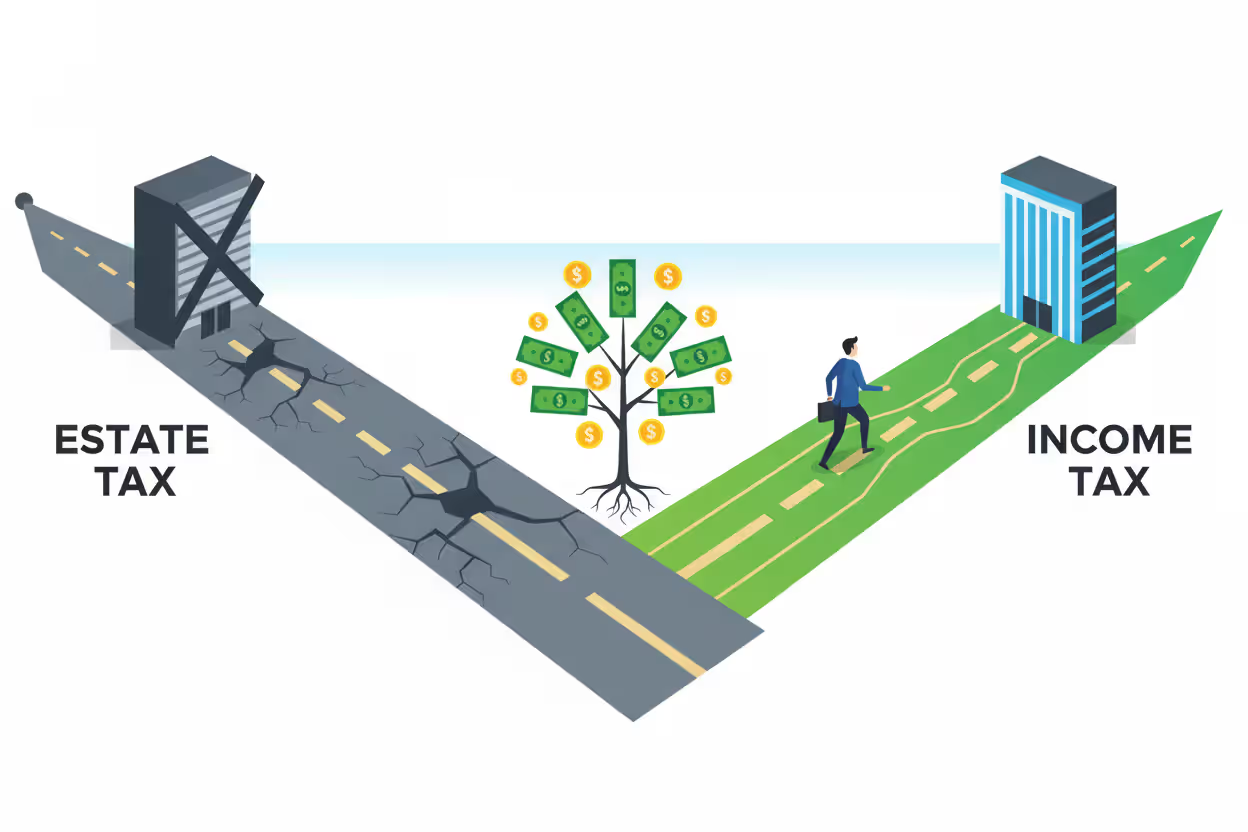
Think of an IDGT as a trust that plays by two different rulebooks simultaneously. You set it up as irrevocable, transferring assets out of your taxable estate. That's rulebook number one: estate tax law. Under these rules, you've made a completed gift. The assets no longer belong to you. They won't be taxed when you die.
But here's where it gets interesting. For income tax purposes—rulebook number two—the IRS still considers you the owner. You personally report every dollar of income, every capital gain, every dividend the trust generates on your Form 1040. The trust essentially doesn't exist in the eyes of income tax law.
Why would anyone want this arrangement? The "defect" (really just a mismatch between income and estate tax treatment) creates powerful tax arbitrage. You're paying income taxes on earnings that benefit your children, not you. Those tax payments represent additional wealth transfer that doesn't count against your gift tax exemption. Meanwhile, assets appreciate inside the trust, completely outside your taxable estate.
Standard irrevocable trusts don't work this way. They're separate taxpayers, filing their own returns (Form 1041) and paying taxes at compressed brackets that hit the top rate—37% in 2026—at just $15,200 of retained income. Individual filers don't reach that same bracket until income exceeds $626,350 (for single filers). That's a massive difference.
Creating the intentional defect involves including specific language in the trust document. Estate attorneys call these "defect triggers." The most common: giving yourself the power to swap assets of equal value in and out of the trust. Another option: retaining the ability to borrow trust assets without posting adequate collateral. These powers violate the grantor trust rules found in IRC sections 671-679, making you the tax owner while keeping assets outside your estate. It sounds backwards, but it's precisely how the strategy works.

Author: Jonathan Whitmore;
Source: harbormall.net
How IDGT Trust Strategy Works in Practice
Setting up an IDGT isn't as simple as signing a trust document. The real power comes from what happens after creation—specifically, how you transfer assets into it.
The Sale Transaction Structure
Most families don't gift assets to their IDGT. Instead, they sell them. You might sell $8 million worth of your closely-held business to the trust, receiving a promissory note in exchange. The trust now owns the business; you own a note promising payment over time.
Here's what that looks like in practice. Say you own a manufacturing company valued at $8 million. You've already "seeded" the IDGT with $800,000 (about 10% of the sale price) through gifts to your children, who are the trust beneficiaries. Now you sell the remaining business interest to the trust for fair market value, taking back a 10-year promissory note at 4.4% interest (the Applicable Federal Rate for mid-term loans as of March 2026).
Each year, the trust owes you principal and interest payments—in this example, roughly $996,000 annually. Where does the trust get that money? From the business income and growth. If the business generates 9% annual returns (pretty reasonable for a well-run company), it produces about $720,000 in cash flow while growing in value by the same percentage.
The trust makes the required note payments, and here's the magic: every dollar of growth above that 4.4% AFR stays in the trust, benefiting your kids instead of sitting in your taxable estate. Over ten years, if the business maintains that 9% growth rate, the spread between investment returns and the note rate transfers roughly $3.6 million to your beneficiaries without any additional gift or estate tax.
You need that initial 10% "seed money" for a crucial reason. Without it, the IRS might argue this wasn't really a sale—it was a gift disguised as a sale. The seed capital gives the trust some equity, making the transaction look like what it is: a leveraged buyout by a trust that happens to benefit your children.
Fair market valuation isn't optional. For that $8 million business, you'll need a qualified business appraiser to document the value. The appraisal should be dated within 60 days of the sale and prepared by someone with appropriate credentials (ASA, ABV, CBA). Mess this up—sell $8 million worth of assets for $6 million—and you've made a $2 million taxable gift.
Income Tax vs. Estate Tax Treatment
This is where the intentional defect earns its keep. When you sell assets to your IDGT, two things happen at once—or rather, one thing happens and one thing doesn't.
What doesn't happen: capital gains tax. Selling appreciated assets normally triggers tax on the gain. You bought that business for $1 million, it's worth $8 million, so you'd expect to pay tax on $7 million of appreciation. Not here. Because you're treated as the owner for income tax purposes, the sale gets ignored. You can't sell something to yourself. No taxable event occurs.
What does happen: estate tax removal. Even though income tax law treats you as the owner, estate tax law doesn't. The sale is respected as a completed transfer. Those assets are gone from your estate, frozen in value at $8 million (actually, frozen at the note balance, which declines as payments are made). Future growth belongs to the trust.
Every year after the sale, you pay income tax on whatever the trust earns. The business generates $720,000 in income? You report it on your return and write a check to the IRS for roughly $266,000 (at 37% federal rates). The trust doesn't pay a dime. Its entire $720,000 stays intact for growth and note payments.
Even the interest on the note gets this treatment. The trust owes you, say, $352,000 in interest payments during year one. You don't report that interest as income. The trust doesn't deduct it. For income tax purposes, the payment might as well not exist. It's just you moving money from one pocket to another.
Think about what you're accomplishing by paying those income taxes. That $266,000 annual tax check represents money leaving your estate (reducing what you'll owe estate tax on) and benefiting your kids (the trust keeps assets that would otherwise be reduced by taxes). You're making a gift without making a gift. The IRS doesn't count these tax payments against your lifetime exemption. They don't require gift tax returns. They're invisible for transfer tax purposes, but very real for wealth transfer purposes.
Author: Jonathan Whitmore;
Source: harbormall.net
Key Benefits of Using an IDGT in Estate Planning
Why go through this complexity when you could just gift assets outright or set up a simpler trust? The benefits, for the right family, justify the effort.
Locking in today's values for estate tax. When your business grows from $8 million to $24 million over fifteen years, that $16 million increase never touches your estate. Your estate tax calculation treats the assets as if they're worth whatever the remaining note balance shows—possibly zero if the note's been fully repaid. Everything above that growth threshold passes to beneficiaries without estate tax. At 40% rates, that's a $6.4 million tax savings on this example alone.
Leveraging low interest rates for outsized gains. The AFR in 2026 hovers between 4.2% and 4.7% depending on the term length. Compare that to historical business returns (10-12% for private companies), real estate appreciation (7-9% in growth markets), or even equity portfolios (historically 9-10%). That spread—often 4 to 6 percentage points—represents pure wealth transfer. You're borrowing from yourself at 4.4% to invest in assets returning 10%. The difference compounds for your kids' benefit.
Making tax-free gifts through tax payments. Here's a benefit people miss: your payment of the trust's income taxes acts as an additional transfer that doesn't count as a gift. Let's say the trust generates $400,000 annually in taxable income. You pay roughly $148,000 in federal taxes on that income. Over twenty years, you've transferred $2.96 million to beneficiaries (the taxes they didn't have to pay) without touching your gift tax exemption. That's on top of the appreciation transfer from the sale transaction.
Building a wall around assets for beneficiaries. Irrevocable trusts, when properly structured, shield assets from beneficiaries' creditors, divorcing spouses, and lawsuits. Your daughter might get divorced—her spouse can't touch the IDGT assets. Your son might face a business lawsuit—plaintiffs can't reach his beneficial interest. The protection varies by state and depends on distribution standards, but it's generally far stronger than outright ownership.
Maintaining flexibility through swap powers. Most IDGTs include your right to substitute assets of equivalent value. Originally sold real estate to the trust, but now you want to swap in S-corporation stock? You can make that exchange. Found a better investment? Swap it in. This power serves double duty: it's one of the defect triggers maintaining grantor trust status, and it's a legitimate planning tool. If the original asset underperforms or becomes illiquid, you're not stuck watching the strategy fail.
| Feature | IDGT | Standard Irrevocable Trust | Revocable Trust |
| Estate tax inclusion | Assets removed; note balance may be included | Assets fully removed | Everything included in gross estate |
| Income tax responsibility | Grantor reports all income on personal return | Trust files Form 1041; pays own taxes or passes income to beneficiaries | Grantor reports income; trust is disregarded |
| Asset protection | Strong shield for beneficiaries against creditors | Strong protection depending on distributions | No protection; grantor retains full control |
| Flexibility | Irrevocable but often includes swap powers | Irrevocable with limited modification options | Fully flexible; can be amended or revoked anytime |
| Complexity | Requires ongoing documentation, valuations, note payments | Moderate complexity depending on assets | Minimal; straightforward administration |
| Best for | Families with $20M+ transferring appreciating assets | General estate tax reduction across wealth levels | Probate avoidance, incapacity planning |
When Grantor Trust Estate Planning Makes Sense
Not everyone needs an IDGT. In fact, most people don't. This strategy shines brightest under specific circumstances.
You have wealth substantially exceeding the exemption amount. The federal estate tax exemption for 2026 sits at roughly $13.99 million per person, $27.98 million for married couples (adjusted each year for inflation). But here's the catch: absent Congressional action, that exemption drops by half in 2026—back to roughly $7 million per person. Families with $20 million or more in net worth have the most to gain. Below that threshold, simpler strategies often work fine.
Your assets are positioned to grow significantly. An IDGT wastes its potential if you sell bonds yielding 4.5% when the AFR is 4.4%. The strategy needs assets that will substantially outperform the note rate. Operating businesses are ideal—they often return 10-15% annually. Growth stocks, commercial real estate in developing markets, or intellectual property rights all work well. Stable, income-producing assets with minimal appreciation? You're better off with different planning.
You can afford to pay taxes on income you don't receive. This is non-negotiable. If the trust generates $500,000 in taxable income annually, you need roughly $185,000 in cash (assuming 37% federal rates) to cover the tax bill. That money can't come from the trust—you have to have other income sources or liquid assets. I've seen families set up IDGTs only to realize the grantor can't sustain the tax payments. The strategy falls apart.
You have at least 10-15 years of life expectancy. IDGTs need time to work. The appreciation has to outpace the AFR by enough to justify setup costs (often $15,000-$40,000) and ongoing administration expenses. A 55-year-old business owner in good health? Perfect candidate. A 78-year-old with health issues? Probably not worth the complexity. If you die before the note is repaid, the remaining balance gets pulled back into your estate anyway.
Your family dynamics support irrevocable planning. Once you sell assets to an IDGT, they're gone. You can't change your mind, reclaim the business, or redirect assets to different beneficiaries easily. This works well when you're certain about who you want to benefit and confident they'll manage the wealth responsibly. Families with uncertain succession plans, adult children with substance abuse issues, or potential disputes should think carefully before making irrevocable transfers.

Author: Jonathan Whitmore;
Source: harbormall.net
State tax considerations work in your favor. Some states add complications. California, for instance, doesn't fully respect federal grantor trust rules—the state might require separate trust tax returns even though the trust doesn't file federal returns. New York has its own estate tax with a lower exemption ($7.16 million in 2026) and a "cliff" structure that can pull the entire estate into taxation. Massachusetts, Oregon, Minnesota—each has quirks that affect IDGT planning. You need state-specific analysis, not just federal tax planning.
Advanced IDGT Planning Strategies and Variations
Experienced planners rarely use IDGTs in isolation. They combine them with other techniques, creating layered strategies that multiply the benefits.
Wrapping life insurance inside the structure. Many families establish an IDGT specifically to own life insurance on the grantor's life. Here's how it works: you make annual gifts to the trust (using your $19,000 per beneficiary annual exclusion in 2026), and the trustee uses those gifts to pay premiums on a $10 million policy. Because the trust is a grantor trust, you're treated as the policy owner for income tax purposes—policy growth remains tax-deferred. But for estate tax purposes, the trust owns the policy. The $10 million death benefit passes to beneficiaries completely free of estate tax. The trust can use the insurance proceeds to buy assets from your estate, providing liquidity, or simply distribute the money tax-free.
Creating dynasty trusts for multiple generations. Why limit the benefits to your children? Structure the IDGT to continue for grandchildren, great-grandchildren, and beyond. By allocating your generation-skipping transfer tax exemption to the initial seed gift (that 10% capital you contributed), you can shelter the trust from estate tax at every generational level. Some states—Delaware, South Dakota, Nevada, Alaska—allow trusts to continue for 365 years or perpetually. Imagine $8 million growing at 7% annually for 100 years, never touched by estate tax. That's over $3.4 billion passing tax-free through multiple generations.
Building in spousal access for financial security. Concerned about losing access to transferred assets? Structure the trust to give your spouse discretionary access to principal for health, education, maintenance, and support. You can't benefit directly (that would pull assets back into your estate), but your spouse can receive distributions. You benefit indirectly through reduced household expenses. This requires careful drafting to avoid reciprocal trust problems—you can't simply exchange trusts with your spouse—but experienced attorneys navigate these issues regularly.
Preserving the option to toggle grantor trust status off. What if circumstances change? Maybe your income tax rates increase dramatically. Perhaps you no longer have the cash flow to pay trust taxes. Maybe the tax laws change, making grantor trust status disadvantageous. Advanced IDGTs include provisions allowing someone (often a trust protector or independent trustee) to "turn off" the defect. They might release the swap power or modify another defect trigger. Once turned off, the trust becomes a separate taxpayer going forward. You lose the benefit of making tax-free gifts through tax payments, but you're no longer burdened with paying taxes on income you don't control.
Layering charitable planning into the mix. Some families combine IDGTs with charitable remainder trusts, charitable lead trusts, or outright charitable bequests. You might sell assets to an IDGT while directing the trust to make charitable gifts that reduce its taxable income. Or structure the trust so that after your children's deaths, remaining assets pass to a family foundation. The combinations are limited only by your planning objectives and your advisor's creativity.

Author: Jonathan Whitmore;
Source: harbormall.net
Common IDGT Implementation Mistakes to Avoid
Even well-designed IDGTs fail when implementation gets sloppy. Here are the mistakes that create problems—and sometimes IRS audits.
Using inadequate or outdated valuations. This is the number one audit target. Sell your business interest for $6 million when it's actually worth $9 million, and you've made a $3 million gift. The IRS will catch it, especially if you die within a few years and they're examining your estate. Always get a qualified appraisal from someone with recognized credentials and relevant experience. The appraiser should have no financial interest in the outcome. The valuation should be dated close to the sale date—not six months before or after. And document everything: the appraiser's methodology, comparable transactions, financial projections, discount rates. If you're valuing a business, include management interviews, industry analysis, and multiple valuation approaches.
Drafting promissory notes with problematic terms. The note must carry interest at the applicable federal rate or higher. Use the wrong AFR (short-term when you should use mid-term, or vice versa), and the difference becomes a gift. Forget to specify adequate security for the loan, and the IRS might challenge the sale. Fail to require regular payments, and the transaction looks less like a legitimate sale and more like a disguised gift. The note should read like a commercial loan document: payment schedule, interest rate, security interest, default provisions, acceleration clauses. Treat it as if you were lending to a stranger, not your children's trust.
Skimping on seed capital to maximize the sale. Yes, you want to transfer as much as possible through the sale (which uses the favorable AFR) versus the seed gift (which uses lifetime exemption). But going below 10% seed capital is risky. Some conservative planners recommend 20-30%, particularly with volatile assets or when aggressive valuations are involved. That seed capital makes the transaction look legitimate—a real buyer would need to put some equity into the deal. Courts have upheld sales with 10% seed capital, but why push the boundaries?
Treating trust assets as personal property. This mistake happens more than you'd think. Because the trust is disregarded for income tax purposes, some grantors forget it's still a separate entity for estate and gift tax purposes. They commingle funds, using trust assets to pay personal expenses. They fail to maintain separate accounts. They treat trust property casually. Don't do this. The trust needs its own bank account, proper titling of assets, separate accounting records, and clear documentation of every transaction. If you want to use trust assets personally, you need to structure that properly—perhaps through the swap power, substituting personal assets of equal value.
Failing to make required note payments. The trust must actually pay principal and interest according to the note schedule. Missing even one payment can jeopardize the entire structure. The IRS might recharacterize the unpaid amounts as additional gifts or argue the original sale was fraudulent. If the trust lacks liquidity to make payments, the trustee needs to address that—perhaps by distributing income-producing assets, refinancing the note (with proper documentation), or making partial payments secured by additional trust assets. Document everything. Keep records showing payments were actually made, on time, in the correct amounts.
Ignoring the requirement to pay income taxes. You must pay income taxes on all trust income. You can't have the trust pay them (that would make it a separate taxpayer, defeating the strategy). You can't skip filing requirements (report the income on Schedule E or the appropriate schedule for the income type). And you can't cherry-pick which income to report—it's all or nothing. The consistent payment of trust income taxes demonstrates grantor trust status, provides the additional wealth transfer benefit, and creates an audit trail showing legitimate implementation.
I've practiced estate planning for twenty-seven years, and I've seen brilliant IDGT strategies collapse because families tried to save a few thousand dollars on implementation costs. A client once used a $3,000 desktop valuation for a $12 million business sale—the IRS challenged it, and we spent $180,000 defending the position, ultimately settling for a $4.8 million gift. The comprehensive appraisal would have cost $18,000. Another family drafted their own promissory note using forms downloaded online, accidentally using a below-market interest rate. That mistake cost them $1.2 million in deemed gifts. These are not DIY projects. The professional fees you pay upfront—typically $15,000 to $40,000 for proper legal work and valuation—are rounding errors compared to potential estate tax savings or the cost of fixing a broken structure
— Margaret Chen
Frequently Asked Questions About IDGT Estate Planning
The Intentionally Defective Grantor Trust stands out as one of the most powerful wealth transfer techniques available to high-net-worth families. By exploiting the split treatment between income and estate taxation, you can freeze asset values, transfer appreciation free of estate tax, and make additional gifts through income tax payments—all without triggering gift tax consequences.
Success demands careful attention to detail: qualified appraisals, properly structured promissory notes, adequate seed capital, consistent note payments, and ongoing income tax compliance. The strategy delivers maximum benefit for families with significant wealth (typically $20 million or more), appreciating assets that will outperform the AFR, sufficient income to pay trust taxes, and a long planning horizon.
The complexity isn't trivial. Neither are the professional fees. But for the right family in the right circumstances, an IDGT can preserve millions of dollars that would otherwise go to estate taxes. Work with experienced estate planning counsel and tax advisors who regularly implement these strategies. The investment in proper setup and administration pays dividends measured not in thousands, but in millions, for the generations that follow.
Related Stories

Read more

Read more




The content on this website is provided for general informational and educational purposes only. It is intended to explain concepts related to estate planning, wills, trusts, tax strategies, and financial legacy planning.
All information on this website, including articles, guides, worksheets, and planning examples, is presented for general educational purposes. Estate planning situations may vary depending on personal circumstances, financial structures, legal regulations, and jurisdiction.
This website does not provide legal, financial, or tax advice, and the information presented should not be used as a substitute for consultation with qualified legal, tax, or financial professionals.
The website and its authors are not responsible for any errors or omissions, or for any outcomes resulting from decisions made based on the information provided on this website.